Inlay & Onlay Fillings – Comprehensive Guide
Dental inlays and onlays are modern restorative solutions designed to repair teeth that are too damaged for a simple filling but not damaged enough to require a full crown. Often referred to as “indirect fillings,” these treatments provide a balance between strength, precision, and aesthetics. Crafted from durable materials such as porcelain, ceramic, or composite resin, inlays and onlays are custom-made in a dental laboratory and then bonded securely to the tooth.
For patients seeking a long-lasting, natural-looking restoration that preserves as much of the healthy tooth as possible, inlays and onlays are considered the gold standard of minimally invasive dentistry.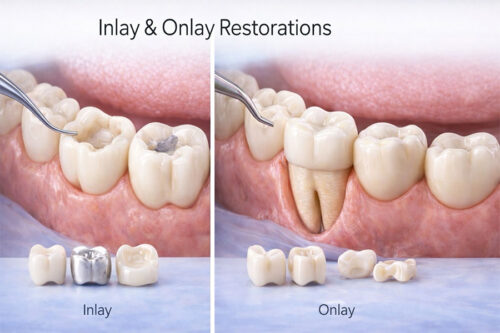
What Is the Difference Between Inlays, Onlays, and Fillings?
- Traditional Fillings: Used when decay is minor. The dentist removes the decayed area and fills it directly with a material such as composite resin.
- Inlays: Recommended when the damage extends into the grooves of the tooth but does not affect the cusps (the raised parts). They fit neatly inside the tooth surface.
- Onlays: Sometimes called “partial crowns.” Onlays cover one or more cusps of the tooth, offering greater coverage than inlays but less than a full crown.
This distinction ensures patients receive the most appropriate treatment depending on the severity of the decay or fracture.
The Step-by-Step Procedure
- Examination & Diagnosis
The dentist evaluates the tooth with X-rays or 3D imaging to assess the extent of damage. - Tooth Preparation
The decayed or weakened area is carefully removed while preserving maximum healthy enamel. - Impression & Temporary Filling
An impression or digital scan is taken. A temporary filling may be placed to protect the tooth until the permanent restoration is ready. - Laboratory Fabrication
Skilled technicians create the inlay or onlay using high-quality porcelain, ceramic, or composite materials. - Bonding & Adjustment
The permanent inlay/onlay is precisely fitted and bonded with strong dental cement. Final polishing ensures a seamless look.
Most treatments require two visits, but with advanced digital CAD/CAM technology, it is sometimes possible to complete the procedure in just one visit.
Benefits of Inlays & Onlays
- Durability: Stronger than regular fillings, lasting 10–15 years or more.
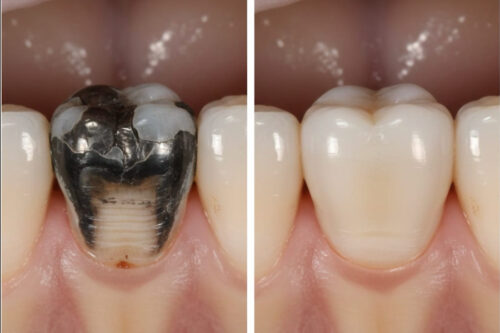
- Aesthetics: Porcelain and ceramic options match natural tooth color.
- Precision Fit: Custom-made for maximum comfort and function.
- Tooth Preservation: Less invasive than crowns, keeping more of the natural tooth intact.
- Resistance: Better withstands chewing forces compared to standard fillings.
- Hygiene: Smooth surfaces make them easier to clean, reducing plaque accumulation.
Aftercare Instructions
- Avoid very hard or sticky foods for the first 24 hours.
- Practice excellent oral hygiene: brushing twice daily and flossing carefully around the treated tooth.
- Attend regular dental check-ups every 6–12 months.
- If you grind your teeth at night, a protective mouthguard may be recommended.
- Mild sensitivity to hot or cold foods may occur for a few days and usually subsides.
Why Choose Inlay & Onlay Fillings in Turkey?
Turkey, especially Istanbul, has become a hub for high-quality dental restorations. Patients from Europe, the UK, and the US often choose Turkey because:
- Affordable Costs: Savings of up to 70% compared to Western countries.
- Expertise: Highly trained dentists with international experience.
- Technology: State-of-the-art digital scanners and CAD/CAM systems.
- Accessibility: Istanbul is easily reachable from most European capitals with short flight times.
- Comprehensive Care: Clinics offer not only dental expertise but also patient-friendly services, including accommodation, transfers, and English/German-speaking coordinators.
Example Cost Overview – Inlay & Onlay Fillings in TurkeyTreatment Type Price (per tooth) Notes Composite Inlay € 250 Aesthetic, durable, suitable for back teeth Ceramic-Porcelain Inlay/Onlay € 300 Most popular, natural look, high strength E-max Porcelain Inlay/Onlay € 350 Premium option, long-lasting, color-stable